Gina Luna
Who will miss you?
Gina Luna’s life in Houston runs through family, civic work and a growing private-investment platform. Her way of deciding where to be begins with a remarkably personal question.
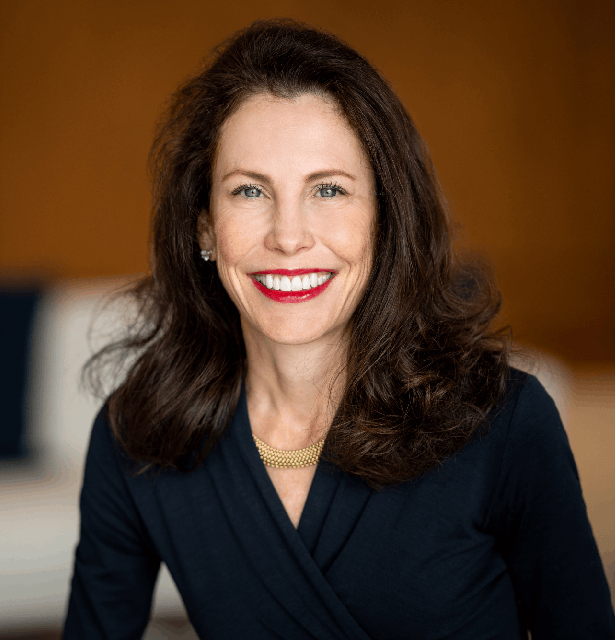
Gina Luna had a useful test for an overcrowded calendar: who would miss her? In a 2016 interview with the Texas Medical Center, she described weighing an evening reception against a child’s game. Another guest at a large function might hardly register her absence. Her child would. She also asked which decision she might regret five years later. The method was personal enough to resist a universal formula and practical enough to use on a Tuesday.
Her Houston career had roots far from the city’s boardrooms. Luna grew up in Hereford, Texas, with grandparents connected to farming and ranching and a father who worked in the local bank. She recalled him serving popcorn in the bank lobby on Fridays after retirement. During a summer internship at Texas Commerce Bank, she met her future husband, Carl, on her second day; he had been assigned to mentor her. Finance, family and the people who made introductions were intertwined early.
The professional arc subsequently grew large. Her current Genesis Park biography records 22 years at JPMorgan Chase, including leadership of the Houston market and Chase Commercial Banking. In 2016 she founded Luna Strategies, advising companies and their leaders on strategy and growth. That move carried accumulated institutional experience into a smaller enterprise, where the questions arrived attached to particular owners and businesses.
In 2021, Luna joined Curtis Hartman, Paul Hobby and Peter Shaper in launching GP Capital Partners, a $275 million small-business investment fund. It offered another route for companies that needed capital to grow, change ownership or reorganize their finances. The founders’ experience was part of the proposition: a business could gain financial resources and people familiar with the decisions that accompany them. Luna was a founding partner of that platform, which operates within Genesis Park.
The distinction between buying a company and financing its next stage is important here. This is a private-investment business with a strong credit component, also providing equity. Its work can involve helping an owner expand while retaining control, or supporting an acquisition alongside another investor. For the people running the underlying companies, the form of the money shapes the relationship: who makes decisions, how repayment works and what happens when the business needs more time.
By March 2025, Genesis Park announced that its second small-business investment fund had closed with $300 million. Together, its two SBIC funds represented $575 million in capital commitments. The first had invested more than $250 million across 18 companies. Fund II expected to make 20 to 25 investments, generally between $10 million and $30 million each. These are fund and investment figures, describing the resources the platform can deploy.
The stated target was a business with at least $10 million in revenue and roughly $3 million to $15 million in earnings before interest, taxes, depreciation and amortization. That is a world of established operating companies, where a financing decision can accompany a founder’s transition or a family’s next chapter. In a 2026 M&A Access conversation, Luna emphasized relationships, reputation and transparency: the transaction begins with understanding whom the business is joining.
Her commitments outside investing are substantial too. Genesis Park lists her as chair of the Texas A&M Foundation board and vice chair of the Welch Foundation. She previously served two terms on the Federal Reserve Bank of Dallas’s Houston branch board, chaired the Greater Houston Partnership and helped lead its UpSkill Houston workforce initiative. The roles keep her connected to education, scientific research and the practical question of how people prepare for work.
Texas A&M is also a family attachment. Luna graduated in 1995; Carl graduated in 1991. When the university foundation announced her appointment as a trustee in 2020, it described their support for Mays Business School, the Association of Former Students and the 12th Man Foundation. They had also joined its Legacy Society through planned giving. Their relationship with the institution stretches from student experience into the opportunities available to people arriving afterward.
There are quieter interests beside those public obligations. A 2016 conference biography named running and reading among her pleasures, a reminder that even a crowded civic résumé leaves parts of a person out. They suggest another way to think about a full life: leave room for activities whose value does not need to appear in the next announcement. The public accomplishments are substantial. The private decisions give them proportion.