Jeff Sheldon
Jeff Sheldon Built a Business Around a Better Working Day.
The Ugmonk founder’s world runs on paper cards, careful design and the freedom to stay small. His most useful creation may be a clearer sense of what deserves his attention.
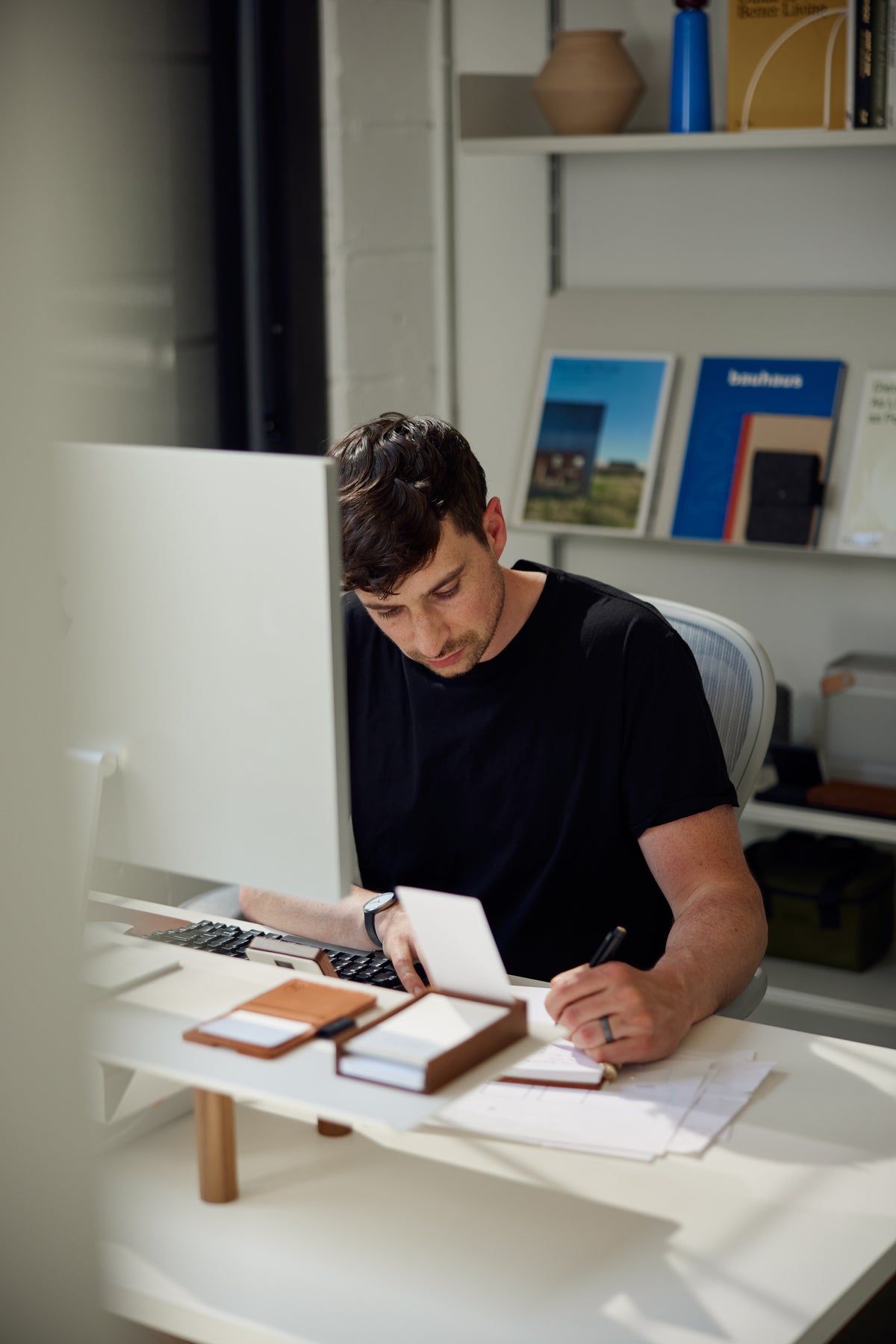
Jeff Sheldon begins with a card. He writes down the work that matters, puts it in a holder on his desk and leaves it where he can see it. The point is partly to remember. It is also to avoid opening a phone, checking one thing and emerging somewhere else entirely.
That small preference has become a substantial part of Ugmonk, the design business he started in 2008. Analog, its paper-based planning system, gives a physical home to a familiar problem: a day can fill up before the important work gets done. On the Yo! Podcast in January 2025, Analog was reported to have generated more than $1 million in product revenue. A card and a place to put it had found an audience.
Sheldon’s first products were graphic T-shirts. For years, people knew Ugmonk through the designs they wore; the move toward objects for the desk followed his interest in making useful things he wanted himself. By his January 2025 interview with Practical Ecommerce, he had left apparel behind. Some customers had followed him from buying shirts to buying tools for their working lives.
The company remains deliberately small. Ugmonk has a four-person team in Downingtown, Pennsylvania, shipping orders itself and answering customers directly. Sheldon says he started without investors or an exit strategy. The ambition is in the object: how it feels, how well it works and whether someone will want to keep using it.
Being small has never meant that the work is effortless. The first Gather desk organizer, launched in 2017, brought manufacturing problems that slowed his plans for a larger system. Developing its successor pushed him toward suppliers he could visit. In 2022, he described being able to drive to the manufacturers within roughly 50 miles of his Pennsylvania base. Proximity let him see what was happening and keep refining the pieces.
His own working environment changed, too. After more than a decade using his parents’ basement as a warehouse, Ugmonk moved into a dedicated headquarters. The business had outgrown one kind of family accommodation. It also gave Sheldon something less visible than storage space: a boundary.
He told Smart Passive Income in 2022 that the short drive to work helped him separate being a father from being a business owner. At home, with young children around, those roles had been difficult to distinguish. A commute of about ten or twelve minutes gave the day an arrival and a departure. For someone selling tools to clarify a desk, the useful change was also geographic.
The creative parts still hold his interest. In 2025, he was continuing to shoot most of Ugmonk’s product photographs because he enjoyed the process and cared about how the objects were presented. He also wrote most of the emails. Growth had brought help with operations and advertising, but he kept work that let him make things and speak in his own voice.
That voice travels beyond the shop. His monthly Five Things I’m Digging newsletter collects discoveries across design, food, music and other interests. The appeal is a person pointing out something worth noticing. Sheldon has described hearing from creators and small businesses after a mention sent people their way. His audience can become an audience for someone else’s work.
His descriptions of time away from design are similarly ordinary: kicking a soccer ball or throwing a football with his children, taking a walk, getting outside. When he works, mellow music provides a background rather than a demand for attention. On a trip to Copenhagen with his wife, he found inspiration in a city he liked for its walkability and design.
He has also had to make room for thinking. Writing about a solo retreat in 2019, Sheldon described cutting three-quarters of his planned goals before leaving. He gave the remaining work specific blocks of time and moved social apps away from his phone’s home screen. The exercise began by accepting how little could reasonably fit.
Ugmonk’s tools belong to that same practical scale. A card cannot make a decision for its owner. It can hold a few priorities still long enough to look at them. Sheldon has built a business by paying close attention to such modest improvements, while keeping the work close to the life around it. There is plenty left to make. First, he has to choose what goes on today’s card.